Learning Comes First
Every feature should answer a meaningful educational need.
Novelty alone is not progress. Technology becomes valuable when it helps a student understand, an educator respond, or an institution support learning more effectively.
About
For centuries, the book has given ideas a place to unfold.
One page introduces a thought. The other gives it context. A reader can pause, compare, return, question, and write without losing their place.
Then learning went digital, and much of that natural rhythm was compressed into a single screen.
READTYCH began with a different possibility.
What if technology could preserve what makes a book so intuitive while connecting students, educators, content, and learning intelligence in entirely new ways?
That question became a patented two-screen Digital Book.
The Digital Book became the beginning of a connected education platform.
And the platform became a much larger ambition:
To help every learning moment connect with what came before and what should happen next.
READTYCH is an education technology company founded in Houston, Texas. We are developing a new learning environment where students can read, write, think, create, and complete their work with greater focus. At the same time, educators and institutions gain the tools to support them more meaningfully.
We are building for the future of education.
But we are beginning where learning has always begun.
With curiosity, a page, and a person ready to understand something new.
The human mind rarely works in one narrow window.
We read and reflect.
We study an example and try the problem ourselves.
We compare one idea with another.
We look at a question while developing the answer.
We return to an earlier thought because something new has changed how we understand it.
Learning moves between information and imagination, instruction and exploration, reading and writing.
Yet many digital devices ask students to experience all of this through one screen, one application, and one view at a time.
A textbook disappears when a notebook opens. Instructions vanish behind the assignment. Feedback becomes separated from the work it was meant to improve. Students spend part of their attention managing the technology that was supposed to help them learn.
READTYCH was created to rethink that experience from the page outward.
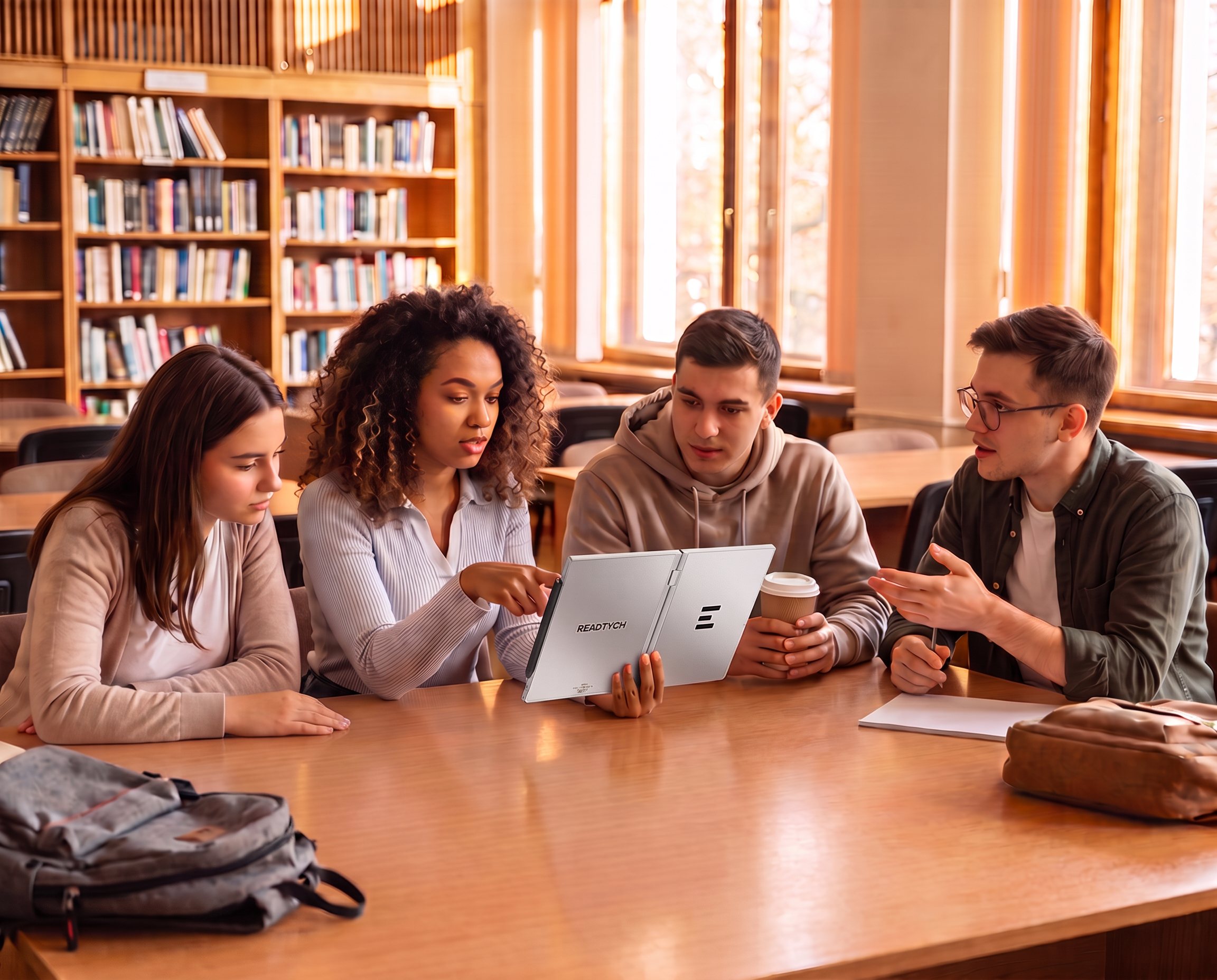
The result is a foldable Digital Book with two internal E-Ink screens. One screen can keep learning material visible while the other gives the student room to write, solve, compare, respond, or explore an approved educational resource.
It opens like something familiar.
What happens inside it is entirely new.
READTYCH brings together the familiarity of a book, the flexibility of a digital device, and the intelligence of a connected education platform.
Students can read on one screen while taking handwritten notes on the other. They can keep a question visible while developing an answer. They can compare passages, examine examples, annotate learning materials, complete assignments, and review feedback without repeatedly losing context.
E-Ink displays create a paper-like environment for reading and writing. Wacom stylus technology allows students to work by hand while keeping their notes and responses organized digitally.
The Digital Book is being developed around the reality of a school day, not the habits of the consumer technology market.
Its purpose is clear.
Help students learn.
That purpose guides the form of the device, the software inside it, the applications schools can approve, and the platform connecting each student with their educators and institution.
This is not technology adapted for education after it was created.
It is technology beginning with education.
A better device can improve the moment in front of a student.
A connected learning environment can improve the journey around that moment.
The READTYCH education platform is being developed to bring books, notes, classes, assignments, assessments, communication, approved applications, feedback, and learning insights into one coherent ecosystem.
A student should be able to understand what they are learning, what needs attention, which materials can help, and what feedback has arrived.
An educator should be able to prepare learning activities, connect them with the right resources, review student work, provide feedback, and recognize where support may be needed.
A school should be able to create a focused digital environment built around approved content, purposeful applications, and the needs of its community.
A district should be able to support more consistent access, implementation, training, and authorized insight across schools.
Each person needs a different view.
The learning journey should still move in one connected direction.

To create a more connected way to learn by bringing reading, writing, classroom work, educator guidance, and responsible learning intelligence into one focused educational environment.
A future where every learner can access the materials, tools, feedback, and support needed to move forward, and every educator can understand more without carrying more.
We imagine a learning environment where a student does not have to search across disconnected systems before beginning an assignment.
Where handwritten thinking can remain part of a digital education.
Where a teacher can see more than a final grade.
Where school technology supports focus instead of competing for attention.
Where approved educational applications can work together inside a trusted ecosystem.
Where useful insights reach educators early enough to make a difference.
Where artificial intelligence contributes speed and context while human judgment remains in charge.
Where a learning history can reveal growth, not simply record outcomes.
Where technology feels less like another system to manage and more like a natural part of teaching and learning.
That future will not come from adding more technology to the classroom.
It will come from giving educational technology a clearer purpose.
Every student enters a classroom with a different story.
Some understand quickly but struggle to express what they know. Some need more time with a concept. Some think best through handwriting. Some learn by comparing examples. Some appear to be doing well until a pattern of missed work reveals something different.
A useful learning system should make room for those differences.
READTYCH is being developed to help students:
Students do not need technology that tries to think for them.
They need technology that gives them more room to think.
Technology in education succeeds when it respects the teacher’s time, experience, and judgment.
Educators already carry the responsibility of planning, teaching, observing, encouraging, assessing, communicating, and responding to the needs of many different learners.
A new platform should lighten that work wherever it can.
READTYCH is being developed to help educators connect learning materials with assignments, review digital and handwritten responses, provide feedback, monitor progress, and identify patterns that may otherwise remain hidden across separate systems.
The goal is not to place a machine between an educator and a student.
It is to help the educator see the student more clearly.
Technology can organize.
It can recognize patterns.
It can suggest.
It can reduce repetitive work.
But context, care, and academic responsibility remain human.
Artificial intelligence is changing what educational technology can recognize, organize, and support.
It may help convert handwriting into searchable content. It may identify recurring difficulties across assignments. It may prepare grading or feedback suggestions for educator review. It may help connect a student with relevant practice or learning resources.
These capabilities could give educators more time and a richer view of student progress.
They also require clear boundaries.
READTYCH is developing its AI-assisted capabilities around a straightforward principle:
AI assists. Educators decide.
A suggestion should remain a suggestion.
A pattern should become a reason to look more closely, not a label placed on a learner.
An insight should support professional judgment, not replace it.
Students deserve the possibilities of advanced technology and the protection of meaningful human oversight.
The future of learning should contain both.
A classroom device cannot succeed on the strength of its hardware alone.
It must fit the routines of educators, the responsibilities of administrators, the institution's technology environment, and the expectations for privacy, security, support, and implementation.
READTYCH is being developed as an educational ecosystem rather than a standalone product.
That means thinking beyond the individual device to consider:
The most revolutionary education technology is not the technology that looks impressive in a demonstration.
It is the technology that continues to make sense on an ordinary Tuesday morning in a real classroom.
Schools already use valuable learning management systems, student information systems, content libraries, assessment tools, educational applications, and communication platforms.
Progress should not require institutions to abandon every useful system they have already built around.
READTYCH is working toward an integration approach that can connect with existing education ecosystems while giving students and educators a more coherent experience.
The aim is not to become one more isolated destination.
It is to help books, notes, activities, applications, feedback, and authorized learning information move through a more connected flow.
Integration requirements will vary across institutions. READTYCH intends to work with participating organizations to understand their current systems, technical needs, security expectations, and implementation priorities.
The future should feel connected because the technology works together, not because every institution is forced into the same mold.
Every feature should answer a meaningful educational need.
Novelty alone is not progress. Technology becomes valuable when it helps a student understand, an educator respond, or an institution support learning more effectively.
Teachers understand the classroom context behind the data.
READTYCH can assist with organization, patterns, and suggestions. Educators retain responsibility for interpretation, feedback, and academic decisions.
More applications, notifications, and options do not automatically create a better learning environment.
We are building a focused ecosystem where educational tools have a clear reason to be present.
Writing by hand is part of how many students process ideas, remember information, work through problems, and develop original thought.
Digital learning should expand that experience, not erase it.
Privacy, security, responsible AI, appropriate access, and institutional transparency cannot be added as finishing touches.
They must shape how educational technology is developed, evaluated, and introduced.
Learning intelligence should help educators recognize where attention may be useful.
It should never reduce a student to a prediction, a score, or a permanent label.
The people using education technology understand realities that cannot be discovered from a distance.
Student experience, educator feedback, institutional requirements, and evidence from real learning environments should guide how READTYCH develops.
A bold vision still has to work in a classroom.
Implementation, training, support, accessibility, reliability, and everyday usability matter as much as the idea itself.
READTYCH was founded in Houston, Texas, a city shaped by science, engineering, medicine, exploration, and people from across the world.
It is a fitting place to ask ambitious questions.
How can a familiar object become the foundation of a new learning environment?
How can hardware and software feel like one educational experience?
How can schools gain the benefits of connected technology while preserving focus, trust, and human judgment?
How can a student’s work tell a more useful story over time?
READTYCH is pursuing those questions through product development, platform design, educational collaboration, and preparation for real-world pilot opportunities.
Our roots are in Houston.
The learning challenges we want to help address are shared much more widely.
READTYCH is progressing through active hardware and software development.
The current product direction includes a patented bifold Digital Book with two internal E-Ink screens, stylus-based writing, an education-focused interface, connected books and classroom tools, approved educational applications, and a broader platform for learning activity and institutional insight.
Additional capabilities under development include handwriting recognition, AI-assisted educator tools, learning analytics, and institutional deployment support.
Final production specifications, integrations, availability, and commercial timelines will be confirmed as development and pilot work progress.
We believe credibility begins with being clear about what exists today, what is being developed, and what still needs to be learned.
The vision is ambitious.
The work remains practical.
Build carefully. Test meaningfully. Listen closely. Improve continuously.
Education technology cannot be fully understood in a design studio, engineering environment, or product presentation.
It has to meet the classroom.
That is why pilot-focused collaboration is an important part of the READTYCH journey.
Working with schools, districts, educators, students, universities, researchers, and education organizations can help explore:
A pilot should do more than demonstrate that a product can operate.
It should help everyone involved understand whether it can improve learning.
The future of learning will not be built by one company alone.
It will require educators who understand students.
Schools willing to explore new approaches thoughtfully.
Districts that can connect classroom needs with long-term planning.
Education departments responsible for access and public outcomes.
Researchers who ask difficult questions and examine evidence.
Publishers who bring trusted learning materials into new formats.
Application developers who create useful educational tools.
Technology partners who understand infrastructure, security, and scale.
And students who will quickly show us which ideas feel natural and which still need work.
READTYCH welcomes conversations with organizations that want to help shape a more focused, connected, and human learning environment.
Partnership should create more than reach.
It should create better decisions.
Education does not need another brief wave of excitement.
It needs technology that can earn a lasting place in the lives of students and educators.
That requires patience where patience matters, urgency where students need better solutions, and humility about everything that can only be learned through real use.
READTYCH is building for that longer horizon.
A product that begins with a familiar book-like form.
A platform that connects the moments around learning.
An intelligence layer that supports human judgment.
An ecosystem designed to grow with the needs of students, educators, schools, and education systems.
The future of education may be digital.
It should also be focused.
It should be thoughtful.
It should be connected.
Above all, it should remain unmistakably human.
READTYCH is an education technology company founded in Houston, Texas. It is developing a patented two-screen E-Ink Digital Book and a connected education platform for students, educators, schools, districts, and broader education systems.
Learning often requires students to keep information visible while writing, solving, comparing, or responding. Two screens can give those activities separate but connected spaces, reducing the need to switch between content and active work repeatedly.
READTYCH is being designed specifically around education. Its book-like foldable form, two E-Ink displays, stylus experience, focused software, approved application environment, and connected learning platform begin with the needs of students, educators, and institutions.
READTYCH is progressing through hardware and software development while preparing for pilot-focused opportunities. Final specifications, availability, and commercial timelines will be confirmed as development advances.
READTYCH is developing AI-assisted tools that may support handwriting recognition, grading suggestions, feedback preparation, learning pattern identification, and relevant resource recommendations. Educators remain responsible for academic interpretation and final decisions.
Schools, charter networks, districts, education departments, universities, researchers, publishers, application developers, and strategic partners can contact READTYCH to discuss pilot opportunities, research, integrations, content, or wider collaboration.
The next page starts here
A book opens, and a new idea enters the room.
A student writes, and that idea becomes their own.
An educator responds, and understanding moves forward.
READTYCH is building the connection between those moments.
Two screens that give learning room to unfold.
One platform that helps the school day work together.
Responsible intelligence that helps educators see more clearly.
A focused environment where technology serves the people learning through it.
We are not trying to predict every detail of tomorrow's classroom.
We are building a better place for tomorrow’s learning to begin.