Platform

Student Performance Analytics That Show What Needs Attention Next

The grade is visible.

The story behind it usually is not.

A final score may not reveal that a student understood the lesson but struggled to explain it in writing. It may not show that the same concept has caused difficulty across several assignments. It can also miss the quiet improvement happening underneath an average result.

READTYCH is developing a learning analytics platform that connects assignments, assessments, submissions, feedback, attendance, and academic performance over time.

An educator can begin with one student.

A school leader can understand a classroom, grade, or subject.

A district or education department can explore authorized patterns across participating schools.

Each view answers a different question. Together, they can help the right people notice what matters while there is still time to respond.

A teacher holding a READTYCH Digital Book in front of a class of students using their own devices.
Chapter I

Schools Have Plenty of Data. What They Need Is a Clearer Story.

Every school day creates information.

A student opens a lesson, writes a response, misses a deadline, improves on the next assignment, struggles with one type of question, and responds well to a particular resource.

Most of those moments are recorded somewhere.

The problem is that they often remain scattered across learning platforms, assessment systems, spreadsheets, attendance records, and teacher notes.

A teacher sees one piece.

A principal sees another.

The district receives a report weeks or months later.

READTYCH is being designed to connect relevant learning activity so authorized users can understand what happened, what may be changing, and where a closer look could help.

The purpose is not to produce more data.

It is to make information easier to learn, understand, and act upon.

Chapter II

One Student. One Classroom. One School. The Bigger Picture.

Education happens at several levels at once.

A student may struggle with a concept. Several students may reveal a pattern in the classroom. Multiple classes may point to a grade-level challenge. Similar results across schools may signal a wider district need.

READTYCH is being developed to enable authorized users to navigate these levels without losing sight of the learner at the center.

01

Student View

A student profile may bring together assignments, assessments, grades, attendance, teacher feedback, strengths, recurring difficulties, and changes over time.

Instead of seeing only the latest score, an educator can review the work behind it and determine whether the result is an isolated case or part of a longer pattern.

02

Classroom View

A classroom overview may show assignment completion, average performance, commonly missed concepts, changes across activities, and students who may need additional attention.

The teacher can begin with the class pattern and open the relevant assignment, question, or student response.

03

Grade and Subject View

School leaders may explore performance across grade levels, subjects, classes, and selected academic periods.

This can help them understand whether a difficulty is limited to one activity or appears more widely across the school.

04

School View

A school-level view may connect academic performance, attendance, assignment completion, grade distributions, and changes across classrooms.

The goal is not to assign a single label to a school. It is to understand where progress is happening and where additional support may be valuable.

05

District View

Authorized district leaders may compare relevant patterns across participating schools, subjects, grade levels, and time periods.

This can help districts investigate wider needs before making decisions about resources, educator development, curriculum, or student support.

06

Education Department View

Where appropriate permissions and agreements are in place, an education department may review approved system-level patterns across schools or regions.

The information may support education planning, program evaluation, resource allocation, and a clearer understanding of larger learning needs.

Start with the system.

Move toward the school.

Open the classroom.

See the student behind the pattern.

Chapter III

A Dashboard Should Answer a Question

Schools do not need another collection of charts that look impressive during a presentation and remain unopened during the school year.

A useful dashboard should answer a real question.

An educator may ask:

Which students may need my attention today?

A school leader may ask:

Is this difficulty appearing in one classroom or across the school?

A district or education department may ask:

Where could additional support or resources make the greatest difference?

READTYCH is being designed to help users move from information to investigation and from investigation to thoughtful action.

The dashboard is not the destination.

What someone can understand and do next is what gives it value.

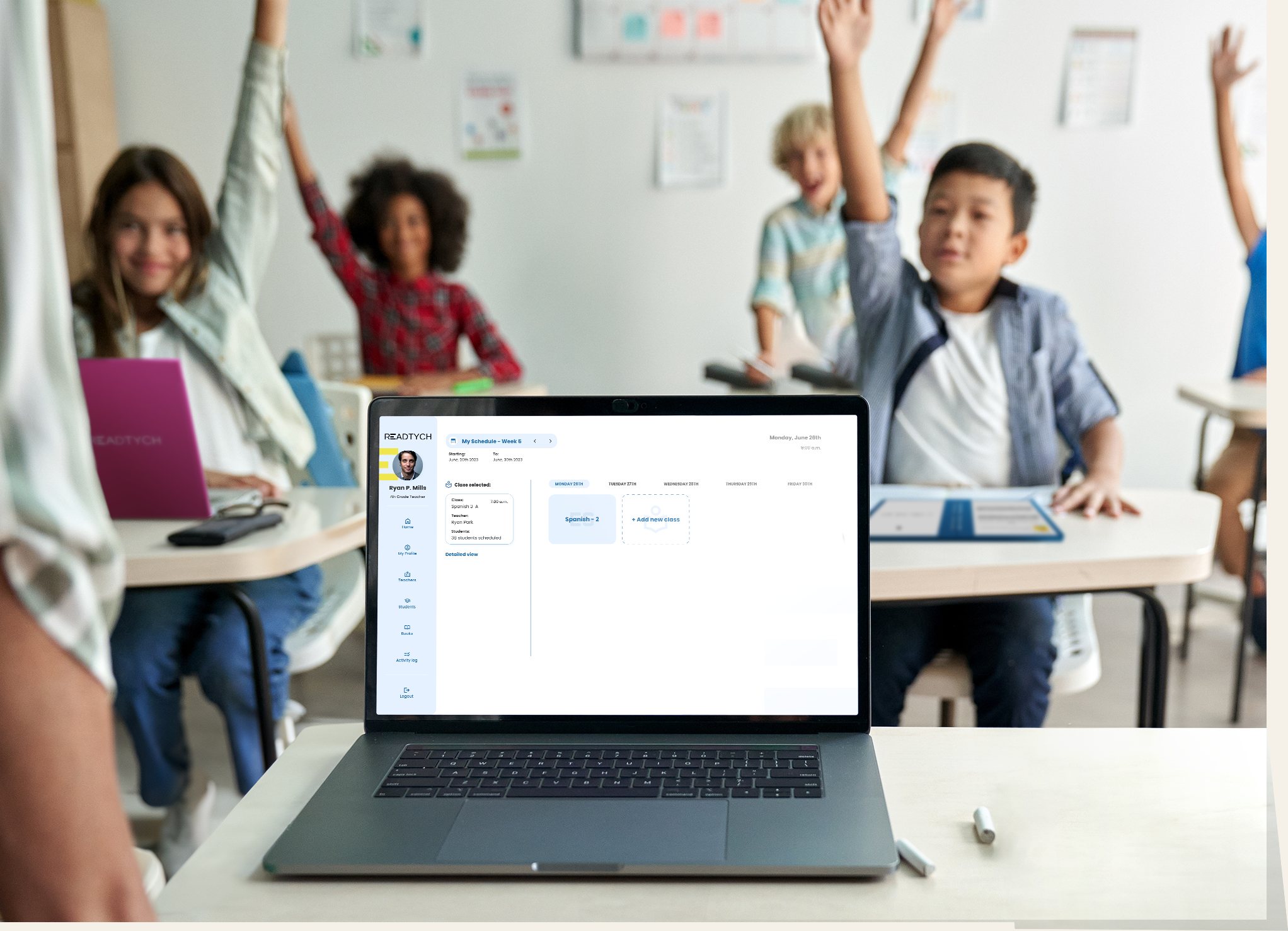
The READTYCH web application open on a laptop in a classroom while students raise their hands.
Chapter IV

Follow the Signal Back to the Work

A warning color or downward arrow is not enough.

If the platform identifies a possible concern, an authorized educator should be able to understand what contributed to it.

A performance signal may connect back to the original assignment, the student’s response, the grade received, previous performance, teacher feedback, completion history, related course material, and attendance information where appropriate.

That context matters.

A declining score could indicate a learning difficulty. It could also reflect missed work, unclear instructions, a different assessment format, or a short-term disruption.

READTYCH is being designed to help educators review the evidence before concluding.

No unexplained label.

No invisible decision.

The signal, the work behind it, and the person qualified to interpret it.

Chapter V

See Performance Across Time

A current grade is a snapshot.

Learning is a sequence.

READTYCH is being developed to connect authorized historical performance across lessons, assignments, quizzes, tests, courses, and academic periods.

01

Recognize Improvement

A student’s overall grade may not change immediately, even when their work is becoming stronger.

Looking across several activities can help educators recognize gradual improvement that might otherwise remain hidden.

02

Understand Repeated Difficulty

One incorrect answer may mean very little.

When the same misunderstanding appears across several activities, READTYCH may bring the pattern to the educator's attention for review.

03

See the Effect of Incomplete Work

A low grade does not always mean the student does not understand the subject.

Missing or overdue assignments may be affecting the result. Completion information can help educators separate the two.

04

Compare Different Types of Work

A student may perform well on objective questions but struggle with written explanations. Another may understand the concept but find timed assessments difficult.

Comparing activity formats may provide the educator with context that one score cannot.

The aim is not to preserve every mistake forever.

It is to retain enough useful context to determine whether today’s result is a single moment or part of something larger.

Chapter VI

A Future Trajectory Is a Signal, Not a Verdict

Historical information and current academic activity may help indicate where performance is headed.

READTYCH is exploring trajectory tools that could highlight a gradual decline, improvement following teacher support, recurring incomplete work, or increasing difficulty within a subject.

These indicators must be handled carefully.

A student’s future cannot be calculated from a chart.

A trajectory should never be presented as a fixed prediction of intelligence, ability, or potential. It is simply a signal based on available information.

The platform may show that current performance is moving in a particular direction.

The educator reviews the work.

The educator considers the student’s circumstances.

The educator decides whether the pattern is meaningful and whether a response is needed.

A trajectory can change.

That is the reason to notice it.

Chapter VII

Help Teachers See Where Their Time Can Matter Most

An educator does not need an algorithm to tell them how to teach.

They may need help finding the student whose difficulty is buried beneath dozens of assignments and hundreds of responses.

READTYCH’s educator analytics are being designed around the everyday questions teachers face.

Which Work Is Still Missing?

A missing assignment is easy to overlook when an educator is managing several classes.

READTYCH may bring submitted, overdue, and incomplete activities into one view, helping the teacher understand whether the issue is isolated or becoming a recurring pattern.

What Did the Class Find Difficult?

If many students miss the same question, the difficulty may not be an individual student's.

The lesson, instructions, or concept may need to be revisited. A classroom view can help the teacher recognize that shared pattern.

Who Is Improving?

Progress is not always dramatic.

A student may move from incomplete answers to partially correct ones before reaching full understanding. READTYCH may help educators see that movement and recognize the effort behind it.

Who May Need a Closer Look?

The platform may highlight changes in performance, repeated difficulties, or incomplete work that deserves attention.

It does not decide that the student has failed. It gives the educator a reason to review the situation.

Chapter VIII

Keep the Insight Connected to the Activity

Student performance analytics should not sit apart from teaching.

READTYCH is developing tools that may allow educators to create or select classwork, homework, quizzes, tests, and written assignments within the platform.

Teachers may be able to connect each activity to a class, course, book, deadline, and set of instructions. Student responses, grades, and feedback can then remain connected to the activity that produced them.

If a pattern appears, the educator does not need to reconstruct the story from several systems.

The assignment, response, result, feedback, and teaching context remain part of the same learning journey.

Chapter IX

Alerts That Respect the Educator’s Attention

An alert can be useful.

Too many alerts become another system educators learn to ignore.

READTYCH is exploring notifications that bring attention to meaningful changes without treating every variation as a problem.

01

Repeated Missing Work

One late assignment may require no intervention. Several incomplete activities could point to a problem with access, organization, understanding, or circumstances outside the classroom.

The alert should invite the educator to investigate, not make the assumption for them.

02

A Change From Usual Performance

A sudden difference from a student’s normal pattern may deserve attention.

The teacher can review recent work and decide whether the change is meaningful, temporary, or already understood.

03

A Class-Wide Difficulty

If many students struggle with the same activity or concept, READTYCH may highlight the shared pattern.

The response may be as simple as explaining the idea differently before the class moves on.

An alert should not automatically label a student, evaluate an educator, or trigger a high-impact decision.

It should say:

Something may deserve a closer look.

The authorized person decides what it means.

Chapter X

AI Can Recognize a Pattern. Educators Understand the Student.

Artificial intelligence can review more information than one person could reasonably process at once.

It may help organize academic activity, recognize handwriting, compare performance across assignments, and identify repetition.

But AI cannot see every part of the student’s life.

It may not know that the student recently changed schools.

That they understand the lesson but struggle to express it in writing.

That a difficult week affected several assignments.

That the teacher has already found a better way to help.

READTYCH is developing AI-assisted capabilities with educator review at the center.

AI may help recognize handwritten responses, suggest possible grades or feedback, identify performance changes, and recommend relevant practice materials.

Those outputs remain suggestions.

The educator reviews the information, adds the context that the system lacks, and makes the decision.

AI assists. Educators decide.

Chapter XI

Show Strengths Alongside Struggle

Analytics should not be designed only to find what is wrong.

A useful student performance profile should also show where a learner is growing.

01

Academic Strengths

A student may demonstrate consistent understanding in a subject, concept, or type of activity.

Making that visible can help educators build on what is already working.

02

Improvement Over Time

A student who has moved from repeated difficulty to partial understanding is making progress, even if the final score is not yet high.

That movement deserves to be seen.

03

Response to Support

If performance improves after additional practice, a new resource, or teacher intervention, the platform may help connect that progress with the support provided.

04

Different Ways of Demonstrating Understanding

A student may be stronger in written work, projects, diagrams, or another assessment format.

Understanding where the learner performs well can help the educator create a fuller picture.

A student should be able to open their progress view and see more than a list of weaknesses.

They should be able to see movement.

Progress is also a pattern worth noticing.

Chapter XII

Institutional Intelligence With the Student Still at the Center

Student-level insight can help one educator.

Connected and appropriately aggregated information may help an entire institution.

01

For School Leaders

A school-level view may help leaders understand whether several classrooms are struggling with the same subject, whether assignment completion is changing, or whether educators need additional resources.

The same view can help leaders recognize progress, study what is working, and support effective practices across the school.

02

For District Leaders

Authorized district users may explore patterns across participating schools, subjects, grade levels, attendance, assignments, and selected time periods.

If several schools are experiencing difficulty in the same area, district leaders can investigate whether the issue relates to curriculum, learning materials, access, educator support, or another factor.

The purpose is not to create another ranking of schools.

It is to understand where support, resources, or further investigation may be valuable.

03

For Education Departments

Education departments may need to understand patterns across districts, regions, or public programs.

Where appropriate agreements, permissions, and safeguards are in place, READTYCH may provide approved system-level information concerning grade and subject trends, attendance, completion, learning access, and changes following a program or curriculum decision.

A system view should not mean unrestricted access to individual student records.

Information should be aggregated where appropriate, limited by role, and connected to a defined educational purpose.

Leaders see the larger picture.

Access to the individual remains carefully controlled.

Chapter XIII

Student Data Should Never Become a Shortcut to Judgment

Connected educational information creates responsibility.

The platform must do more than show what can be measured. It must also protect the person being measured.

01

Appropriate Access

A student, teacher, principal, district leader, and education department should not automatically see the same information.

Access must reflect each person’s role and responsibility.

02

Educational Purpose

Student information should be used for authorized teaching, learning, support, and institutional needs.

It should not quietly become material for unrelated commercial use.

03

Human Review

A data point, AI suggestion, or trajectory indicator should not independently determine a significant academic decision.

An authorized person must review the information and its context.

04

Data Minimization and Retention

READTYCH should collect only what is reasonably necessary for the approved purpose.

Institutions and READTYCH must also define why information is retained, how long it is needed, and when it should be deleted.

05

No Targeted Advertising

Student personal information should not be sold or used to build behavioral advertising profiles.

This commitment must be reflected in READTYCH’s technology, vendor relationships, contracts, and privacy practices.

Intelligence without trust is not educational progress.

Privacy, security, and governance must be part of the platform from the beginning.

Chapter XIV

From Signal to Support

An insight becomes useful only when it leads to a thoughtful response.

01

Another Explanation

If several students struggle with the same concept, the educator may revisit it using a different example, activity, or explanation.

02

Focused Practice

A student may receive activities related to the specific area causing difficulty, rather than additional work across the entire subject.

03

A Better-Fit Resource

The teacher may recommend another book, lesson, example, or an approved educational application that presents the idea differently.

04

Wider Support

Where appropriate, a tutor, counselor, specialist, support team, school leader, or district resource may become involved.

The platform does not choose the intervention.

It helps the people responsible for learning understand what may be worth trying.

Chapter XV

Build the Analytics With the People Who Will Use Them

READTYCH is progressing through platform development while preparing for pilot-focused opportunities.

Student performance analytics should not be introduced widely before educators and institutions understand whether the information is accurate, useful, explainable, and appropriately governed.

A pilot can help answer five important questions.

Are the Dashboards Understandable?

Educators and leaders should be able to understand what they are seeing without needing a data specialist beside them.

Are the Signals Useful?

The pilot can reveal which indicators lead to meaningful review and which ones create unnecessary noise.

Is Enough Context Provided?

Users should be able to understand why a pattern appeared and examine the work behind it.

Do Permissions and Safeguards Work?

Students, educators, school leaders, districts, and education departments should receive only the access appropriate to their responsibilities.

Does the Information Lead to Better Support?

The most important question is whether an insight helps an authorized person respond more thoughtfully to a student, a classroom, a school, or a wider need.

Chapter XVI

Frequently Asked Questions

What are student performance analytics?

Student performance analytics connect relevant academic information to help authorized users understand progress, assignment completion, recurring difficulties, strengths, and changes over time.

What information may appear in READTYCH analytics?

Depending on institutional configuration and permissions, analytics may include assignments, assessments, grades, student responses, teacher feedback, completion, attendance, classes, courses, and historical performance.

Can READTYCH predict student performance?

READTYCH is exploring trajectory indicators based on historical performance and current academic activity.

These indicators are intended to show where attention may be useful, not predict a student’s intelligence, ability, or future.

Who can access student performance information?

Access is intended to be based on institutional roles and approved permissions.

Students, educators, school leaders, districts, and education departments should receive different views appropriate to their responsibilities.

Does READTYCH automatically make decisions about students?

No. READTYCH may use AI to assist with pattern recognition, handwriting recognition, grading suggestions, feedback, and learning recommendations.

Educators and authorized institutions remain responsible for decisions.

How can an institution explore READTYCH analytics?

Schools, districts, education departments, universities, and research partners can contact READTYCH to discuss institutional goals, privacy requirements, pilot scope, platform readiness, and evaluation measures.

The next page starts here

See the Pattern. Understand the Context. Change What Happens Next.

A student misses one question.

Then the same difficulty appears in another assignment.

The class begins to show the same pattern.

The school notices.

An educator gets the chance to respond.

That is the value of connected learning intelligence.

Not knowing everything about a learner.

Knowing enough to notice when something may help.