Reading and Note-Taking
A book, chapter, or lesson can remain open while the student writes notes with the Wacom stylus.
Solutions
A student opens a book. A teacher shares an assignment. A question becomes a handwritten response. Feedback returns. A school leader notices where support may be needed.
These moments belong to the same learning journey. Yet in many schools, they live across separate devices, notebooks, portals, applications, and reports.
READTYCH for schools is being developed to reconnect them.
The two-screen Digital Book gives students a focused place to read, write, compare, and complete their work. The connected education platform helps educators organize learning materials, manage assignments, review responses, and provide feedback.
School leaders gain a clearer view of how the learning environment is working without stepping between the educator and the student.
One school. Many classrooms. A more connected way to move learning forward.

Most schools already have technology.
There are laptops, tablets, digital textbooks, learning management systems, classroom applications, assessment tools, communication portals, and spreadsheets.
The challenge is not simply gaining access to one more tool.
The challenge is helping everything work together.
Students should not need to search through several systems before they can begin an assignment. Teachers should not have to move information from one platform to another simply to understand what happened. School leaders should not have to wait for the end of a grading period to recognize a pattern that may need attention now.
READTYCH is being built around the complete school experience.
It connects the place where students learn with the tools educators use to guide them, and the information schools need to provide better support.
Students often need to see one thing while doing another.
They may need the textbook while taking notes. The question while writing an answer. The example while solving a problem. The source while developing an argument. The teacher’s feedback while revising the original work.
A conventional screen often makes students choose which part stays visible.
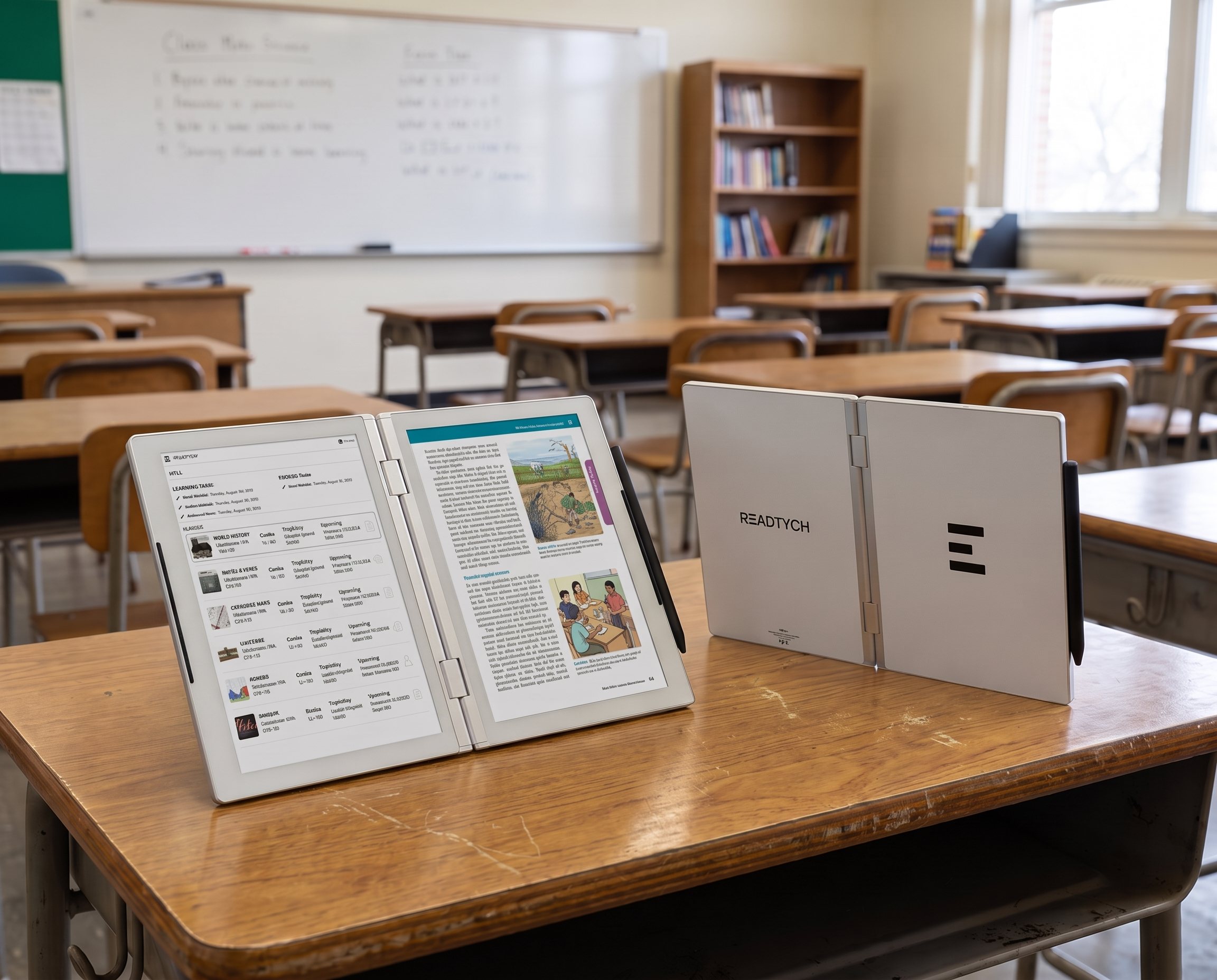
The READTYCH Digital Book opens to reveal two internal E-Ink screens. Students can keep learning material on one side while working with it on the other.
A book, chapter, or lesson can remain open while the student writes notes with the Wacom stylus.
Students can keep a prompt or set of instructions visible while developing a written answer beside it.
An example, formula, or diagram can remain in view while the student works through the activity.
Two passages, sources, illustrations, or interpretations can be viewed side by side.
A student can review educator comments beside the original response and understand what needs to change.
Two screens are not there to encourage more multitasking.
They are there to protect the student’s train of thought.
Teachers already carry the intellectual and emotional work of the classroom.
They plan lessons. Explain difficult ideas. Adjust activities. Review assignments. Provide feedback. Answer questions. Notice changes in student behavior. Support students who may not know how to ask for help.
Technology should support that work, not create another layer of administration around it.
READTYCH is being developed to help educators:
AI-assisted tools may help with handwriting recognition, repetitive grading tasks, feedback preparation, and identifying learning patterns.
The educator remains responsible for the final academic decision.
Technology can carry more of the routine work. Teaching remains human.
An assignment should not appear as an isolated instruction inside a portal.
Students need to understand what they are being asked to do, why it matters, which materials belong to the activity, and where they can find help.
With READTYCH, an educator may be able to connect an activity with:
The student receives more than a task.
They receive a clearer place to begin.
When the work is complete, the response can return through the same environment. Feedback can remain connected to the assignment and become part of what the student learns next.
A school day creates many small moments of learning.
READTYCH is being designed to help students and educators move through those moments without constantly rebuilding the context.
Assigned textbooks, lessons, readings, and educational resources can remain organized by class and subject.
Students can create handwritten or typed notes and connect them to a book, course, lesson, or idea.
Activities, materials, announcements, deadlines, and educator communication can remain associated with the correct class.
Students can find instructions, complete work, submit responses, and return to educator feedback through one connected environment.
Schools can provide access to useful digital tools without opening the device to every consumer application.
Assignments, assessments, feedback, completion, attendance, and academic activity may contribute to a clearer view of student progress over time.
Everything has a place.
More importantly, each part remains connected to the learning it supports.
School leaders need to understand how students and classrooms are progressing.
They do not need another collection of charts without context.
READTYCH is developing student performance analytics that could help authorized school leaders explore relevant patterns across classrooms, subjects, grade levels, assignments, and academic periods.
A principal or authorized administrator may be able to ask:
The purpose is not to place a single label on a student, educator, classroom, or school.
It is to help authorized people understand where a closer look may be useful.
Every pattern should lead back to context. Every important decision should return to a qualified person.
A general-purpose tablet is designed to do almost everything.
That includes streaming entertainment, opening social media, downloading consumer applications, browsing unrestricted content, and running games.
A school device needs a clearer purpose.
READTYCH is being developed as a controlled educational environment. Schools may determine which books, resources, and applications are available based on curriculum, grade level, policy, security, and educational goals.
This can support:
Students can use useful digital resources within an environment centered on education.
Books, applications, and learning tools can be organized around school and classroom requirements.
Educators and students can work within a shared learning environment rather than several unrelated systems.
Schools can define access according to approved roles, resources, and responsibilities.
Focus does not always require removing technology from the classroom.
Sometimes it requires giving technology a better reason to be there.
A useful education platform should not make every classroom look the same.
The tools may be shared. How educators use them should remain shaped by the subject, lesson, students, and teaching approach.
Students may read and annotate a passage, compare texts, develop responses, and revise their work beside educator feedback.
An example or formula can remain visible while students solve problems, write calculations, and explain their reasoning.
Students may review diagrams, procedures, or data while recording observations and developing explanations.
Two sources can be compared side by side while students identify differences, assess evidence, and build an argument.
Students may organize reading, notes, assignments, and supporting resources around their own learning needs.
Questions can remain visible while students respond. Feedback can stay connected to the work during revision.
READTYCH provides the learning environment.
Educators decide how that environment supports the lesson.
Schools should not have to choose between ignoring AI and allowing it to make decisions no one can properly explain.
READTYCH is exploring AI-assisted capabilities that may support:
These capabilities are intended to assist educators, not replace their judgment.
AI-generated suggestions may be incomplete, inaccurate, or inappropriate for a particular student or situation. Educators should be able to review, change, or reject any suggestion before it influences an academic decision.
AI can recognize a pattern.
The teacher understands the person behind it.
Student information deserves more than a privacy statement added after the product has been built.
Schools need clear answers about what information is collected, why it is needed, who can access it, how it is protected, and how long it is retained.
READTYCH’s platform direction includes:
Students, educators, school leaders, district representatives, and education departments should receive different views based on approved responsibilities.
Student information should be used for authorized teaching, learning, support, and institutional needs.
Only information reasonably necessary for an approved purpose should be collected and used.
A data point, AI suggestion, or performance indicator should not independently determine a significant academic outcome.
Student personal information should not be sold or used to create behavioral advertising profiles.
Specific privacy, security, retention, access, and governance requirements will be established through the agreements and notices applicable to each institutional deployment.
Introducing new education technology is not simply a matter of delivering devices.
Schools must prepare educators, accounts, content, applications, networks, permissions, student support, technical processes, and families.
READTYCH is preparing for pilot-focused adoption that begins with a defined educational need.
Understand the school’s goals, existing technology, classroom routines, curriculum, connectivity, and concerns.
Identify participating classes, educators, students, subjects, workflows, and measures of success.
Prepare devices, accounts, roles, connectivity, content, applications, and relevant integrations.
Introduce the technology through real classroom activities rather than isolated feature demonstrations.
Begin with selected lessons and workflows that the school and READTYCH can support properly.
Listen to students, educators, administrators, and technical teams. Review usability, adoption, performance, and implementation readiness.
Use what the pilot reveals to strengthen the device, platform, training, support, and deployment approach.
Decide whether the school should pause, improve, continue, or consider broader adoption.
A school should not have to commit to a larger future before understanding the classroom experience.
Teachers do not need a tour of every feature before they have used the first one.
Training should begin with familiar classroom questions:
How do I share a lesson?
How does a student open it?
How can both screens support the activity?
Where does completed work appear?
How do I review a handwritten response?
How do I return feedback?
What happens when a student needs additional support?
READTYCH educator training is being designed around practical workflows, guided onboarding, classroom use, and continued feedback.
The goal is not to turn teachers into product specialists.
It is to help them use the technology confidently without losing the teaching practices that already work.
Technology adoption does not end when the accounts are created.
Schools need support when a device behaves unexpectedly, an educator needs help with a workflow, a user cannot access an account, or an application does not work as planned.
Depending on the pilot or institutional agreement, READTYCH support may include:
Support expectations, service levels, responsibilities, and escalation paths should be agreed before a pilot or deployment begins.
Operational confidence grows when schools know what will happen when something needs attention.
A pilot allows a school to move beyond a demonstration and understand what happens during a real school day.
The school may evaluate:
Can students understand the Digital Book and use both screens naturally?
Can teachers prepare, distribute, review, and respond to work without unnecessary difficulty?
Does READTYCH support the selected lessons, subjects, and learning activities?
Do the device, stylus, software, battery, connectivity, and synchronization perform reliably enough for the planned use?
Can the school provide the books, resources, and approved tools students need?
Do the permissions, access controls, notices, and institutional safeguards meet the school’s requirements?
Do educators and technical teams receive enough preparation and assistance?
What would need to improve before READTYCH could support more classrooms or students?
The aim is not to prove that every feature works perfectly.
It is to learn what works, what does not, and what deserves to happen next.
A focused place to read, write, organize, complete assignments, receive feedback, and follow their learning.
Connected tools for lessons, activities, student work, feedback, and earlier support.
Authorized school-level insight into academic activity, implementation, adoption, and areas that may require attention.
A way to connect approved content, classroom resources, educational applications, and learning goals.
A defined environment for device preparation, accounts, connectivity, permissions, applications, and support.
Relevant information that may help authorized professionals understand where additional academic support could be valuable.
A potentially clearer connection to assignments, deadlines, feedback, and school communication, depending on the institution’s configuration.
Different roles need different tools.
The school needs them to move in the same educational direction.
A school does not need to arrive with a complete deployment plan.
Begin with the challenge.
Perhaps students are constantly switching between books, notebooks, and applications.
Perhaps educators are spending too much time reconnecting information.
Perhaps the school wants a more focused alternative to a general-purpose tablet.
Perhaps leaders need a clearer way to understand academic patterns without losing the individual student behind them.
Tell READTYCH what your school wants to improve.
That question can become the beginning of a focused pilot, product demonstration, or future planning conversation.
READTYCH is a two-screen E-Ink Digital Book and connected education platform being developed for students, educators, schools, districts, and education systems. It brings reading, handwriting, assignments, feedback, approved applications, and learning insights into one education-first environment.
READTYCH may help a school connect student devices, educational content, classroom activities, educator workflows, feedback, and authorized learning insights. The exact configuration would depend on the school’s goals, existing technology, policies, and pilot scope.
READTYCH is intended to support an institutionally controlled learning environment. Schools may determine which approved books, resources, and educational applications are available based on curriculum, grade level, policy, and student needs.
READTYCH is being developed as a connected device and education platform rather than simply another learning management system. Whether it complements, integrates with, or replaces an existing tool will depend on the school’s current systems and implementation requirements.
READTYCH’s platform direction includes role-based access, data minimization, educational-purpose limitations, human review, and protection against targeted advertising uses. Specific privacy, security, retention, and governance requirements would be established through applicable institutional agreements.
Schools can request a product demonstration or submit a Pilot Program application. READTYCH will review the school’s educational goals, proposed participants, technical environment, timeline, and alignment with current product readiness.
The next page starts here
A school is more than its devices, platforms, reports, and systems.
It is a student trying again after receiving the right feedback.
An educator finding another way to explain a difficult idea.
A principal recognizing where support could make a difference.
A technology team making sure the experience works when the lesson begins.
READTYCH is being built to connect those moments without taking away the human judgment that gives them meaning.
One student.
One classroom.
One school moving learning forward together.