Reading and Language Arts
Students can read a passage while writing notes, answering questions, or comparing sources.
Solutions
From a single classroom to a more connected district, READTYCH brings student devices, educator workflows, approved learning tools, and academic insights into a single education-first environment.
A district can purchase thousands of devices.
That does not mean teachers will have one less system to manage, students will have a more focused place to learn, or school leaders will understand what is happening across classrooms.
Technology creates value only when it works for the people expected to use it.
READTYCH is being built around that reality.
The two-screen Digital Book provides students with a focused space to read, write, and complete their work. The connected education platform helps educators distribute learning materials, review responses, provide feedback, and see where students may need support.
For districts, READTYCH offers more than an educational tablet.
It offers a foundation for connecting devices, content, classroom activity, educator workflows, and authorized learning insights across schools.
Many districts already use laptops, tablets, digital textbooks, learning management systems, assessment tools, communication platforms, digital libraries, and classroom applications.
The challenge is what happens between them.
Teachers move information from one system to another.
Students search for materials across different applications.
School leaders receive reports after the moment to intervene has passed.
Technology teams support tools that were never designed to work together as a single learning environment.
Families may struggle to understand where grades, assignments, deadlines, and announcements are located.
Another general-purpose tablet cannot solve that fragmentation on its own.
READTYCH is being developed to reconnect the experience around the people who use it every day.
Students.
Educators.
Schools.
Districts.
A district technology decision eventually becomes part of a teacher’s working day.
If the system is difficult to use, teachers carry the difficulty.
If platforms do not connect, teachers bridge the gaps manually.
If implementation is rushed, teachers are expected to make it work during class.
If the technology creates more steps than it removes, adoption becomes another responsibility.
READTYCH is being designed to support educators as they:
The district gains value because the teacher gains a more workable classroom experience.
Adoption does not begin with a training presentation.
It begins when an educator can see how the technology helps on Monday morning.
Students frequently need to view one thing while working on another.
A textbook and a notebook.
A question and an answer.
An example and a problem.
A passage and a written response.
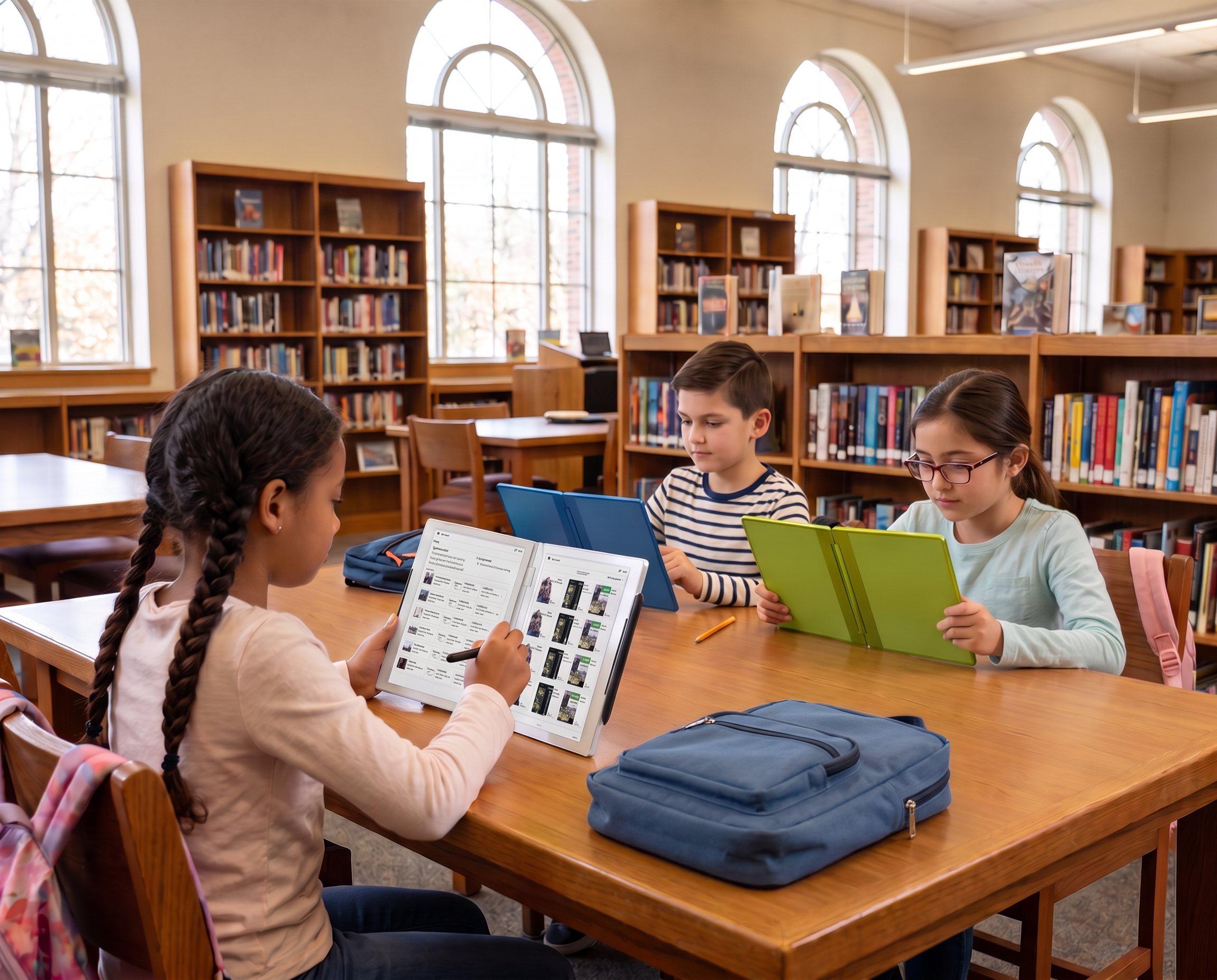
The READTYCH Digital Book opens to reveal two internal E-Ink screens.
Students can keep the learning material visible on one screen while using the second to write, solve, compare, annotate, or complete an assignment.
For educators, that can support:
Students can read a passage while writing notes, answering questions, or comparing sources.
An example or formula can remain visible while students show their work on the second screen.
Students can view diagrams, instructions, or data while recording observations and explanations.
Two historical sources, maps, or documents can be compared side by side.
Questions can remain visible while students provide typed or handwritten responses.
A student can keep the main lesson open while using an approved supporting resource beside it.
The two-screen form does not dictate how teachers should teach.
It gives their lessons more room to work.

Districts need consistency.
Educators need professional freedom.
Those goals should not conflict.
READTYCH is being developed to provide a shared environment for books, classes, assignments, approved applications, submissions, feedback, and learning information.
Within that environment, educators can still shape activities around:
A common platform does not have to mean identical classrooms.
It can mean that students know where to find their work, teachers know where to review it, and authorized leaders know where to look for relevant patterns.
A district cannot add hours to the school day.
It can examine where educators are losing them.
Teachers spend time searching for submissions, checking objective answers, entering information into different systems, matching feedback with assignments, and rebuilding a student’s history from scattered records.
READTYCH is developing tools that may help reduce some of that repetition.
The lesson, instructions, learning materials, student response, grade, and feedback can remain part of the same activity.
Typed and handwritten responses can return through one classroom environment.
Appropriate question types may be scored automatically.
The platform may suggest possible grades, comments, or areas that need attention for teacher review.
Educators may be able to see commonly missed concepts, incomplete assignments, and changing performance more clearly.
The teacher remains responsible for the final decision.
Technology helps with the movement and organization of the work.
Educators bring the judgment.
District leaders are being asked to make decisions about artificial intelligence while the technology is still changing rapidly.
The question is not simply whether a platform uses AI.
The more important questions are:
What is the AI allowed to do?
Who reviews its output?
Who remains accountable?
READTYCH is developing AI-assisted capabilities for:
For academic decisions, the educator remains in control.
A teacher can approve, change, or reject a suggestion.
AI does not independently determine a final grade.
This principle can help districts explore useful AI applications without removing professional judgment from the classroom.
AI assists.
Teachers decide.
District data often becomes visible after a grading period, assessment cycle, or school year has ended.
By then, the student may have struggled through several lessons.
READTYCH is being designed to help authorized educators see relevant patterns earlier.
A teacher may be able to recognize:
The purpose is not to create another wall of data.
It is to help educators answer practical questions:
Who may need help?
What are they struggling with?
What evidence supports that concern?
What could we try next?
A useful insight should lead to a useful action.
A district needs to understand the larger system.
That view should not erase the student inside it.
READTYCH is being developed around different levels of authorized information.
May see individual and class activity, submissions, performance, feedback, and learning patterns relevant to their courses.
May see school-level patterns across classes, subjects, grades, assignments, and attendance.
May see authorized comparisons and trends across participating schools.
May access approved system-level information as required by broader programs.
The platform is intended to help district leaders identify:
The district sees the pattern.
The educator still sees the student.
Districts invest in valuable books, applications, and digital resources.
Students should be able to find and use them without having to navigate an unrestricted consumer environment.
READTYCH is developing a controlled educational application ecosystem where districts and schools can determine which tools are available.
This may help districts:
The goal is not to close students off from useful technology.
It is to give approved technology a stronger role in supporting learning.
Consumer tablets are designed for entertainment, social media, gaming, shopping, browsing, and general communication.
That makes them flexible.
It also means the lesson competes with everything else the device can do.
READTYCH is purpose-built for education.
Schools can decide which books, applications, and learning resources students can access. The E-Ink screens create a more paper-like environment for reading and writing. The platform keeps classroom activity connected.
For educators, that can mean:
Focus should not depend entirely on the teacher asking students to close another tab.
The device itself can be designed with a clearer purpose in mind.
Districts are responsible for providing educational opportunities across schools, communities, and varying levels of access.
Yet students may have very different experiences with devices, connectivity, books, applications, and support.
READTYCH’s long-term direction includes institution-led deployment designed to help schools provide a more consistent learning environment.
That may include:
The aim is not to claim that one device can solve the digital divide.
It is to give districts another way to build more consistent access around real educational use.
A new platform affects more than the classroom.
District technology teams need to understand device management, connectivity, user access, applications, software updates, support requirements, data permissions, and system integration.
READTYCH is being developed with institution-level deployment in mind.
The current direction includes:
Students, educators, school leaders, and district administrators receive access appropriate to their responsibilities.
Schools and districts can determine which educational tools and content are available.
Books, notes, classes, assignments, and school information are intended to be connected to student and educator accounts.
Relevant content and school activities may synchronize across devices and platforms.
The platform is designed to reflect institutional hierarchies rather than treating every user as an independent consumer account.
Districts may begin with selected schools, grade levels, subjects, or classroom use cases before considering broader adoption.
Final privacy, security, data governance, integration, device-management, and technical requirements will need to be confirmed with participating districts before deployment.
The purchase price is only one part of a district technology decision.
The real cost may also include:
READTYCH is being developed around an integrated hardware-and-software model.
Its potential value should be evaluated through questions such as:
A device creates value when it becomes part of learning, not when it reaches the inventory list.
District-wide change should not begin with thousands of unopened boxes.
It should begin with a clear question:
What problem are we trying to solve?
A READTYCH pilot can help a district explore:
The pilot should include educator feedback from the beginning.
Teachers can help identify where the platform fits, where it creates friction, and what needs to change before more classrooms are involved.
Define the educational goals, target users, existing systems, technical environment, and measures of success.
Select participating schools, educators, students, subjects, or grade levels.
Prepare devices, user accounts, connectivity, permissions, approved content, and required applications.
Introduce the Digital Book and platform through real classroom workflows.
Begin with specific lessons, activities, or use cases instead of changing everything at once.
Gather input from educators, students, administrators, and technology teams.
Refine the product, platform, training, and implementation approach based on what happened in practice.
Use the evidence from the pilot to determine whether, where, and how broader adoption should proceed.
The future may be ambitious.
The path toward it should be practical.
Adoption should be tested in real classroom workflows, not assumed based on a product demonstration.
The pilot should focus on defined needs such as fragmented learning tools, student distraction, disconnected assignments, or limited classroom insight.
Training should be connected to actual lessons and tasks rather than isolated feature demonstrations.
A phased pilot allows the district to evaluate value before considering wider adoption.
Teachers remain responsible for grades and academic decisions. Educators review AI-assisted suggestions.
Access should reflect each user’s role and the district’s approved permissions and governance requirements.
Measures should be agreed upon before the pilot and may include usability, educator adoption, student engagement, workflow fit, technical performance, and implementation readiness.
READTYCH is being developed to connect student devices, books, classroom activities, approved applications, educator workflows, feedback, and authorized learning insights across participating schools.
Educators may use READTYCH to share learning materials, manage assignments, review student work, provide feedback, monitor completion, and recognize where students may need additional support.
Integration requirements will depend on the district’s current technology environment. Required connections for learning management, student information, identity, content, and device management should be evaluated during pilot planning.
READTYCH is intended to provide a controlled, education-first environment in which districts and schools determine which approved books, resources, and applications are available.
READTYCH is developing AI-assisted tools for handwriting recognition, grading suggestions, feedback support, learning patterns, and personalized recommendations. Educators retain control over academic decisions.
District leaders can contact READTYCH to discuss educational goals, existing systems, pilot scope, participating schools, implementation requirements, and measures of success.
The next page starts here
The future of education is often presented as a collection of devices, dashboards, algorithms, and data.
But inside every classroom, the future still depends on an educator making hundreds of human decisions.
When to explain again.
When to ask another question.
When to challenge a student.
When to give them more time.
When to recognize progress.
READTYCH is not being built to stand between the teacher and those decisions.
It is being built to provide better tools, clearer context, and more time to make them.
For districts, that is where meaningful adoption begins.
Not with the device.
With the educator who can finally see why it belongs in the classroom.