For Reading Activities
Students can keep a book or passage open while taking notes, answering questions, or comparing information.
Solutions
You did not become an educator to spend the day moving information between platforms.
You are here to teach, question, explain, encourage, challenge, and notice what a student may not know how to say.
READTYCH is being built to support that work.
For educators, READTYCH connects lessons, books, assignments, student responses, feedback, and learning insights in a single environment.
The Digital Book gives students a focused place to learn.
The platform gives teachers a clearer way to guide what happens next.
You remain at the center of the classroom.
Technology takes care of more of the carrying.
A lesson rarely lives in one place.
The book may be in a digital library. The assignment is in a learning management system. Student responses arrive through another platform. Grades go somewhere else. Messages are spread across email, classroom applications, and school portals.
Then there are the spreadsheets.
The reminders.
The missing submissions.
The student who appears to be doing fine until several pieces of work reveal otherwise.
Education technology was supposed to make teaching easier.
Too often, it gives educators another system to manage.
READTYCH is being developed to reconnect the pieces of the school day so teachers can spend less time searching for information and more time acting on it.
Technology should adapt to the work of teaching.
Teachers should not have to reshape every lesson around software limitations.
With READTYCH, an educator may be able to prepare or select:
The teacher can connect the activity to a class, add instructions, include supporting materials, and set a deadline.
Students receive more than an isolated task.
They receive the lesson with the context needed to begin.
The platform organizes the activity.
The educator gives it meaning.
Students often need to see one thing while doing another.
They may need the question while writing the response.
The textbook while taking notes.
The example while solving a problem.
The source while developing an argument.
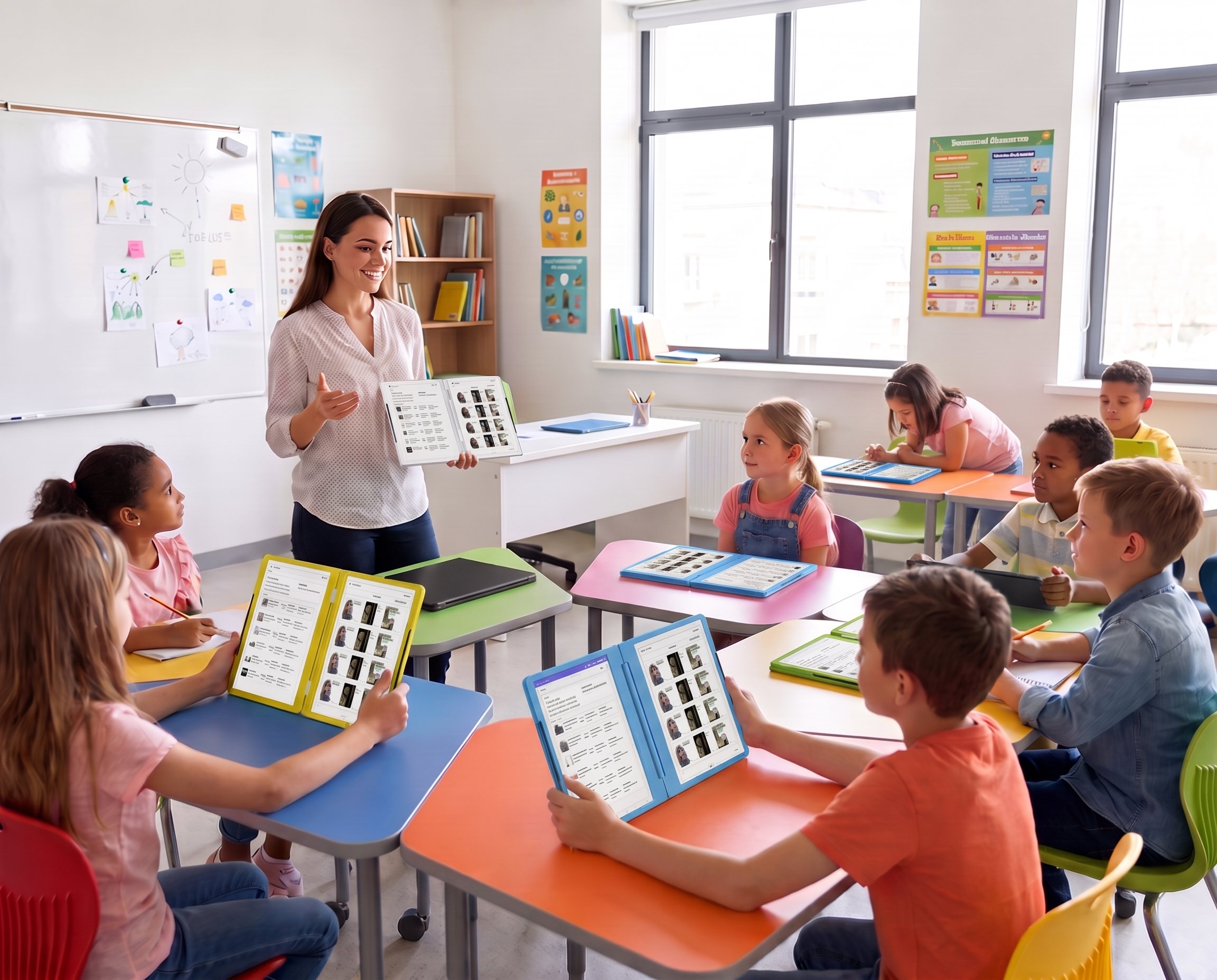
The READTYCH Digital Book features two internal E-Ink screens, so both parts of the activity can remain visible.
Students can keep a book or passage open while taking notes, answering questions, or comparing information.
An example, formula, or instruction can remain visible while the student works through the problem.
Students can view a diagram, experiment, or data set while recording observations and explanations.
A source, prompt, or teacher instruction can stay open while the student develops a response.
Questions can remain visible while students complete their answers, whether handwritten or typed, on the second screen.
Less unnecessary switching gives students more room to stay with the task.
For teachers, that means the technology supports the lesson's structure rather than interrupting it.

The work of an assignment does not stop when it is shared.
Educators still need to see who has started, who has submitted, what students understood, where they struggled, and what feedback would be helpful.
READTYCH is being designed to support that complete journey.
Create or select the activity and connect it with the appropriate course, materials, and instructions.
Send the activity to the relevant students or class.
View completion and submission information without manually rebuilding the record.
Open the student’s work with the original assignment and related context.
Provide a grade, correction, comment, recommendation, or request for revision.
Connect the activity and feedback to the student’s developing learning history.
The assignment stays connected from the moment it is created until the student understands what to do next.
Student work can arrive in many forms.
Multiple-choice answers.
Typed paragraphs.
Handwritten responses.
Calculations.
Diagrams.
Annotations.
Long-form assignments.
READTYCH is being developed to consolidate those responses into a single, organized review environment.
An educator may be able to see:
Teachers spend less time reconstructing what happened.
They can begin where their expertise is most valuable: understanding the response.
Artificial intelligence can work quickly.
That does not mean it understands everything.
It may recognize a pattern without understanding the student behind it. It may suggest a grade without knowing the classroom discussion that came before the answer. It may notice an error without understanding why the student made it.
READTYCH is developing AI as an assistant to educators, not an authority over them.
The platform may help convert handwritten student work into organized, searchable digital content.
Appropriate question types may be scored automatically, reducing repetitive checking.
AI may suggest a possible grade, comment, or area that needs attention.
The system may help identify common errors or prepare feedback for teacher review.
AI may highlight repeated difficulties, missed work, or changes in performance over time.
Every academic suggestion remains subject to educator review.
You can accept it.
Change it.
Reject it.
Add the context the technology cannot see.
The final decision remains yours.
A final grade tells you what happened at one point in time.
It may not tell you that the same student has struggled with a concept across four assignments. It may not reveal that they understand the material verbally but find written responses difficult. It may not show the slow improvement happening beneath an average score.
Teachers often recognize these patterns through experience, observation, and countless small classroom moments.
READTYCH is being designed to make relevant patterns easier to see.
Depending on the school’s settings and permissions, educators may be able to review:
The platform does not replace what you notice.
It helps bring more of the evidence into view.
Students need more than a score.
They need to understand:
What did I do well?
Where did I lose the thread?
What should I try differently?
What can help me improve?
Through READTYCH, teachers can connect feedback directly to the student’s work.
That feedback may include:
Students can review the feedback next to the original response or the related lesson.
The comment no longer sits at the bottom of a page the student may never open again.
It remains part of the learning journey.
Teachers should not have to compete with every application on a consumer tablet.
READTYCH is intended to provide a controlled educational environment where schools determine which books, tools, and applications students can access.
Students still gain the benefits of digital learning.
They can use interactive resources, educational applications, digital books, and connected classroom tools.
But unrelated entertainment, social media, consumer games, and unrestricted applications do not need to sit beside the lesson.
That can give educators:
The goal is not to turn the classroom into a locked screen.
It is to clarify the purpose of the screen.
New technology often arrives with the suggestion that everything educators already do should be replaced.
READTYCH takes a different view.
The platform should support diverse subjects, lesson structures, and teaching approaches.
AI may offer assistance. It does not make the final academic decision.
Students can continue writing, annotating, calculating, and drawing with a stylus.
The Digital Book is built around the natural relationship between reading and writing.
Technology supports the lesson. It does not become the lesson.
No platform can replace the moment an educator recognizes confusion, asks the right question, or gives a student the confidence to continue.
The future of education still needs a teacher at its center.
Educators need to understand the class as a whole while still seeing the students within it.
READTYCH is being designed to provide both views.
The purpose is not to create more charts.
It is to help a teacher answer a practical question:
Where is my attention most useful today?
No technology can remove the complexity of teaching.
It can reduce some of the repetition around it.
READTYCH may help educators spend less time:
That time can return to work that needs a person.
Preparing the lesson.
Supporting the student.
Explaining the concept differently.
Having the conversation.
Noticing the progress that a dashboard might miss.
A primary school teacher, a high school mathematics teacher, a special educator, a language instructor, and a university professor do not work in the same way.
READTYCH is being developed as a flexible education environment rather than a single fixed teaching template.
The platform may support:
The tools may be shared.
How they are used remains shaped by the educator, the subject, and the students.
The strongest education technology is not designed around assumptions about teaching.
It is developed with educators who understand what happens after the bell rings.
READTYCH is preparing for pilot opportunities that can help answer practical questions:
Educator feedback should not arrive after the platform is finished.
It should help shape what the platform becomes.
Giving a teacher a new device is not the same as helping them use it well.
Successful adoption requires time, guidance, and a clear reason for every change.
A READTYCH pilot may include:
Understanding the school’s existing tools, classroom routines, objectives, and concerns.
Setting up devices, user roles, classes, content, and approved applications.
Showing teachers how the Digital Book and platform support actual classroom activities.
Beginning with selected lessons and workflows instead of attempting to change everything at once.
Listening to educators and students as they use the technology.
Adjusting the product, platform, training, and implementation approach based on real experience.
Technology adoption should not feel like something done to teachers.
It should feel like something built with them.
READTYCH is being developed to help educators distribute lessons, connect learning materials, manage assignments, review student work, provide feedback, monitor progress, and identify areas where students may need support.
READTYCH is intended to connect hardware, books, notes, classroom activities, approved applications, and learning insights. Final integration and replacement decisions will depend on the institution’s existing technology and pilot requirements.
READTYCH is developing AI-assisted grading suggestions for appropriate objective, written, and handwritten responses. Educators remain responsible for approving, changing, or rejecting suggestions and making final academic decisions.
The platform is intended to allow educators to prepare or select assignments, connect them to courses and learning materials, add instructions and deadlines, distribute them, and review student responses.
READTYCH is being designed as a controlled educational environment. Schools can determine which approved books, resources, and applications are available to students.
Educators, schools, districts, universities, and education agencies can contact READTYCH to discuss pilot goals, classroom needs, implementation requirements, and participation opportunities.
The next page starts here
It looks like an educator noticing that a student has gone quiet.
Finding another way to explain the idea.
Writing a comment that changes how someone sees their own ability.
Recognizing progress before the student recognizes it.
READTYCH cannot replace those moments.
It is being built to give you more time, context, and room to create them.
Technology can organize the work.
AI can assist with the repetition.
Data can reveal a pattern.
But teaching still belongs to the teacher.